In this guide
Finishing a course creates a useful pause point. It does not automatically change how you work. The next challenge is transfer: choosing a situation where the learning applies, getting any necessary permission, trying it under suitable conditions, and examining the result. A small two-week experiment can help you make that transition without turning every course into a large project.
Boston's public development resources include skill-building opportunities, while its Digital Literacy Initiative distinguishes identifying needs from planning action. The two-week structure here is this publication's own optional method. It is not a City timetable, a requirement, or evidence that a particular course has been approved for workplace use.
Select one technique you can describe plainly
Review your notes and choose a technique that relates to a real learning need. Explain it in a few sentences without copying a provider's proprietary materials. If you cannot yet describe when it is useful or what its limits are, start by clarifying those points. Repeating a phrase from the course is not the same as understanding the method.
Avoid choosing the most advanced or impressive topic merely because it appeared near the end. A small, reusable skill may be the better candidate. For example, distinguishing a decision from an open question in meeting notes could be more immediately testable than redesigning an entire collaboration process.
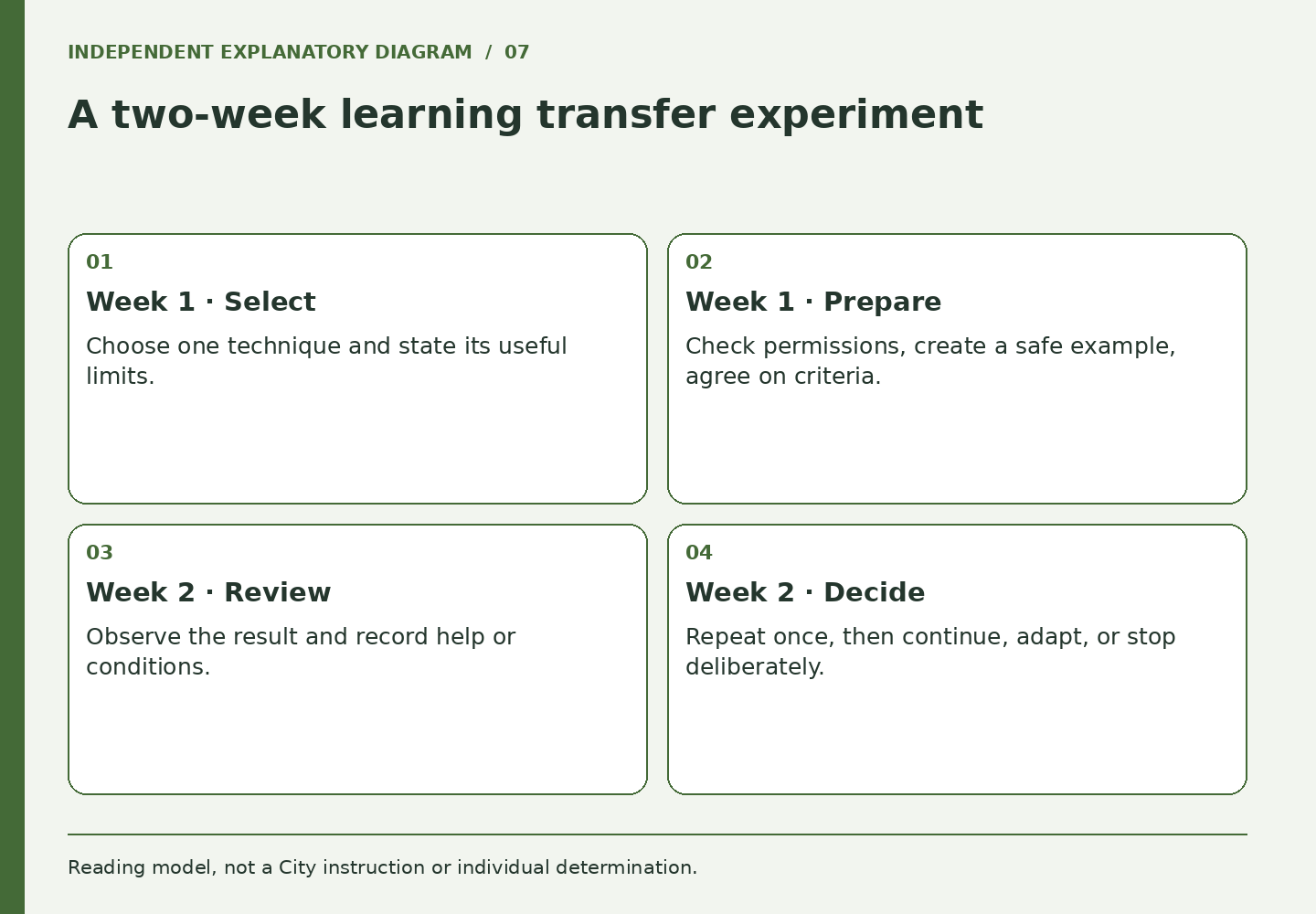
Week one: prepare a permitted attempt
Identify a low-risk practice setting and the necessary approvals. Use fictional material or an approved training environment. Decide what you will produce and what success would look like on this example. Arrange a suitable review if one is needed. Keep the task small enough that you can actually examine the result, rather than merely reporting that you were busy.
Write down the support you expect to use: a checklist, your course notes, a demonstration, or a willing colleague's feedback. Support is not cheating. Recording it helps you understand the conditions under which you can currently perform the task and whether the next attempt should use less help or a more complex example.
Week two: review and repeat deliberately
Compare the result with the criteria you chose. Was the explanation accurate? Could the reader identify the next step? Did your checking method find the deliberate inconsistency? Ask what evidence supports the answer. A favorable impression may be useful, but it is different from a demonstrated result.
Choose one adjustment for a second attempt. Use a new example with similar difficulty, change the audience, or reduce one prompt. Do not introduce every possible complication at once. The purpose is to find out whether the technique is becoming usable, not to stage a dramatic final exam for yourself.
Separate learning value from operational impact
You may be able to show that you completed an exercise more reliably. That does not prove that a department saved time or improved a service. Operational claims need suitable evidence and often a much larger review. Describe the result at the level the experiment supports: a clearer sample, a better explanation, or a remaining gap.
If the method seems promising for real work, discuss a separate authorized trial with the appropriate person. Course completion and a successful practice artifact do not give you permission to alter an official procedure or distribute a new template as policy.
Decide whether to continue, adapt, or stop
Close with three lines: what I can now do on this kind of task, what still needs support, and what I will try next. Continue if the method is useful and the conditions allow it. Adapt if the skill matters but the exercise was poorly matched. Stop if the activity is no longer relevant or a prerequisite needs attention first.
The two-week label is a convenient boundary, not a deadline to manufacture success. Adjust it to your actual schedule. What matters is completing the loop from instruction to evidence, then making a deliberate choice about the next learning step.