A course catalog is an awkward place to begin when your real concern is that an everyday task feels harder than it should. The titles may be appealing, but they cannot tell you whether you need new knowledge, more practice, a clearer process, or permission to work differently. Start with one situation you want to handle better. Course selection becomes easier when it follows a question instead of substituting for one.
Boston Human Resources publicly describes a Learning and Development function that supports employees and departmental operations. The exercise here is an independent planning method for approaching those opportunities. It is not a City assessment, a performance rating, or a requirement to disclose weaknesses to anyone.
Describe a moment, not a personality
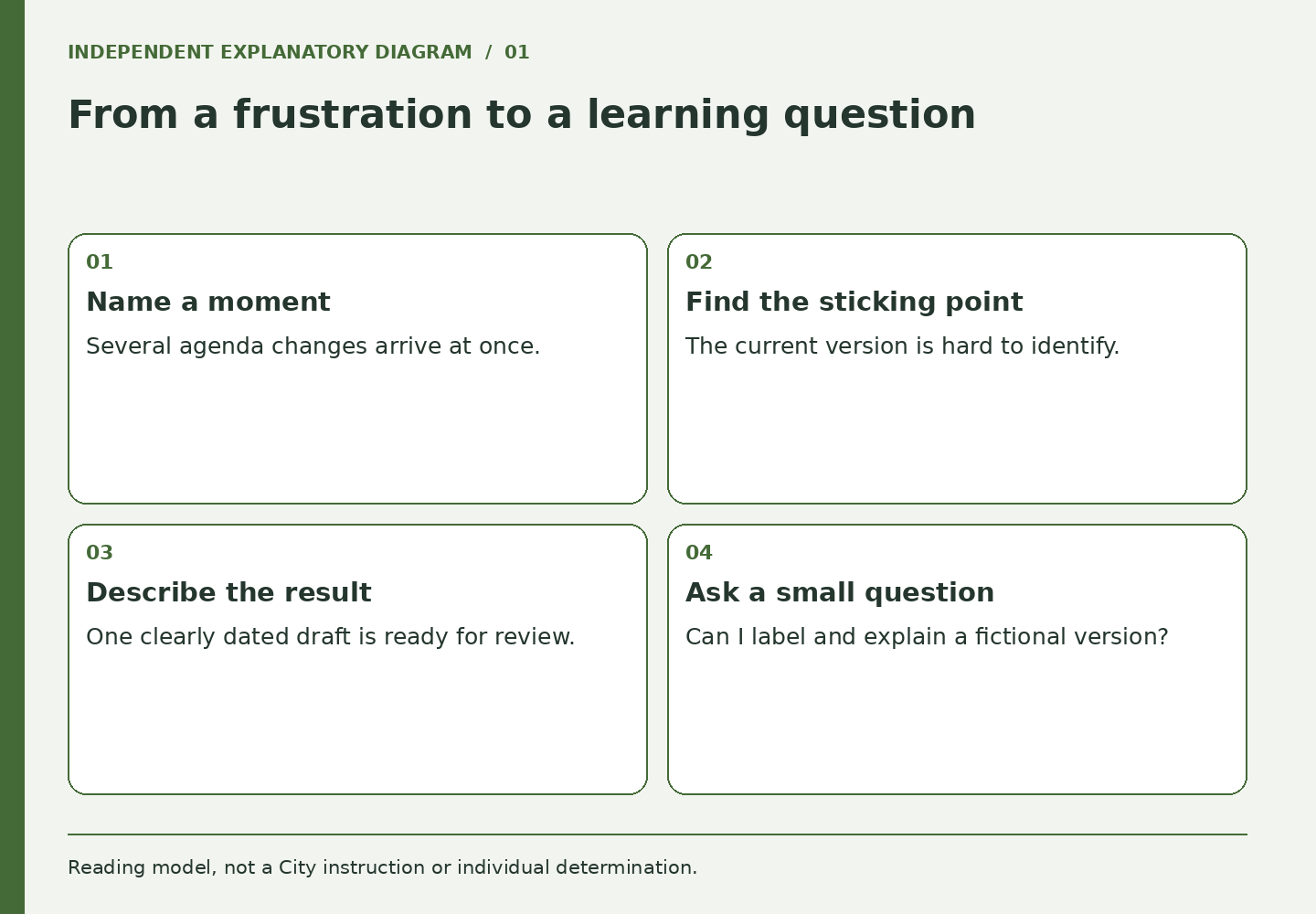
Replace “I need to become more organized” with a situation you can picture: “When I receive several changes to a meeting agenda, I have trouble making the current version obvious.” Replace “I am bad at data” with “I can enter figures, but I cannot reliably explain why two totals differ.” The narrower sentences point toward practice you can observe. They also keep a frustrating afternoon from becoming a sweeping judgment about your ability.
Write three parts on paper: the task, the sticking point, and the useful result. For an agenda task, these could be collecting changes, tracking versions, and producing one clearly dated document for review. Use fictional or public material in this first sketch. Names, resident cases, personnel information, and operational details are unnecessary for defining the learning question.
Check whether learning is actually the missing piece
Some problems will not improve after another webinar. A person cannot practice a process they have never been authorized to use. Conflicting instructions may require a decision from the responsible supervisor. A tool that does not support an essential workflow may require technical help. Missing time may require a workload conversation. These explanations can coexist with a genuine skill gap.
Ask yourself what would happen if you already had the skill. Would you have the information, authority, equipment, and time to use it? If the answer is no, identify that dependency before paying for instruction. You can still learn, but you should not promise that training alone will solve the workplace problem.
Make a testable learning question
A useful question has an action and a boundary. “Can I build a readable agenda with a version label using an approved template?” is more testable than “Can I master office productivity?” “Can I explain a chart's denominator in plain language?” is more useful than “Can I become analytical?” You are choosing a first learning target, not defining the limit of your ambition.
Choose a low-stakes test that takes minutes rather than changing a live service. Read a short lesson, create one fictional example, and ask a suitable reviewer whether the result communicates what you intended. If no reviewer is available, compare your work against explicit criteria and mark your conclusions as provisional. Self-review is helpful; it is not independent verification.
Decide what the result will change
Before starting, write one decision you will make afterward. If the task is already comfortable, choose a more advanced exercise. If you understand the idea but struggle with execution, seek guided practice. If terminology is the obstacle, start with an introductory explanation. If an organizational dependency prevents a fair test, ask the responsible person about that dependency before expanding the project.
Keep the output modest: one question, one example, one observation, and one next step. The point is to create evidence you can use, including evidence that you chose the wrong starting point. A small experiment that redirects you toward the right support is a successful learning decision, even when it does not end with a course enrollment.