In this guide
A small learning project can become a real workplace change surprisingly quickly. A practice spreadsheet gets reused. A draft checklist starts circulating. A colleague assumes an experiment has been approved because it looks finished. Drawing a clear boundary at the beginning lets you learn without creating confusion about which process people should follow.
Boston Human Resources describes training as supporting departmental work and employee development. That public description does not authorize a particular experiment. The responsible workplace process still determines what you may change, which tools you may use, and who can approve an operational result. This fieldbook's boundary card is a planning aid, not that approval.
Name the exercise and its non-goals
Use a plain title: “Practice explaining a sample chart” or “Draft an example meeting checklist.” Add one sentence stating what the exercise will not do. It will not replace a current procedure, publish guidance, contact residents, or modify a shared record. Choose the relevant boundaries rather than copying a long generic disclaimer nobody will read.
Specify a finish line that produces a learning artifact. “Create one fictional example and ask for feedback” is bounded. “Improve the department's reporting” could require broad authority, access, coordination, and review. You can learn something useful without committing yourself or your colleagues to a larger project.
Identify the resources that need permission
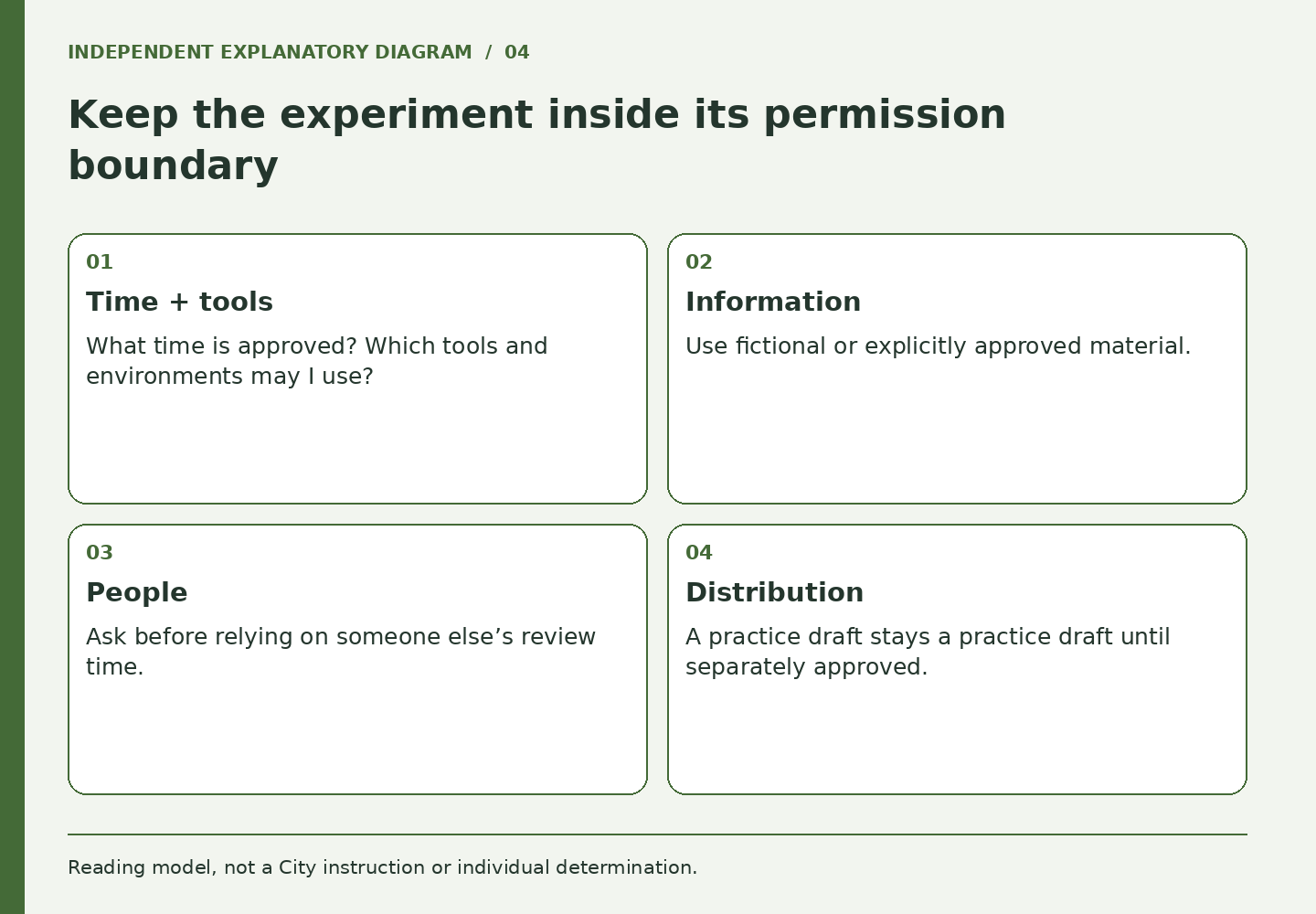
Check five categories: time, tools, information, people, and distribution. Does the exercise use paid work time? Does it require a new account, software installation, or external service? Will it involve internal records? Are you asking a colleague to spend time reviewing it? Who will see the result? A positive answer does not mean the plan is wrong; it means a real dependency needs to be understood.
Use the established supervisor, training, technology, or information-governance channels that apply to your setting. This publication cannot tell you which individual has authority in your department. When you are unsure, ask who owns the decision rather than treating informal enthusiasm as approval.
Prefer fictional data with realistic structure
You can practice many skills using invented entries that reproduce the shape of a task without reproducing its contents. For a tracking exercise, use fictional dates, categories, and descriptions. Include deliberate inconsistencies so you can practice checking. Clearly label the file as a learning sample so another reader does not mistake it for an official record.
Removing names from a live record is not always enough to make it safe to share. Dates, unusual circumstances, addresses, small groups, and free-text descriptions may still identify people or reveal sensitive operations. If you need a real example, obtain the necessary permission and handling instructions first. Do not upload employer information to a course platform or AI tool merely because the exercise asks for a workplace case.
Choose review before distribution
Arrange for a suitable person to review the learning result within the approved setting. Ask whether the method makes sense, what assumptions you missed, and whether any part could be useful for a later authorized project. Keep that review separate from a decision to implement the artifact. A technically correct sample can still be unsuitable for a live workflow.
If the exercise reveals a promising improvement, prepare a new proposal with its own scope and approval path. State what you learned and what remains untested. Do not silently expand the original experiment or assume that approval to practice includes approval to deploy.
Close the loop
At the end, record the skill attempted, the permitted materials used, the feedback received, and where the result belongs. Follow applicable retention and handling instructions for work materials. Your personal learning note can often describe the lesson without containing the underlying file. A well-bounded experiment leaves behind clearer understanding, not an unofficial process that others now have to untangle.