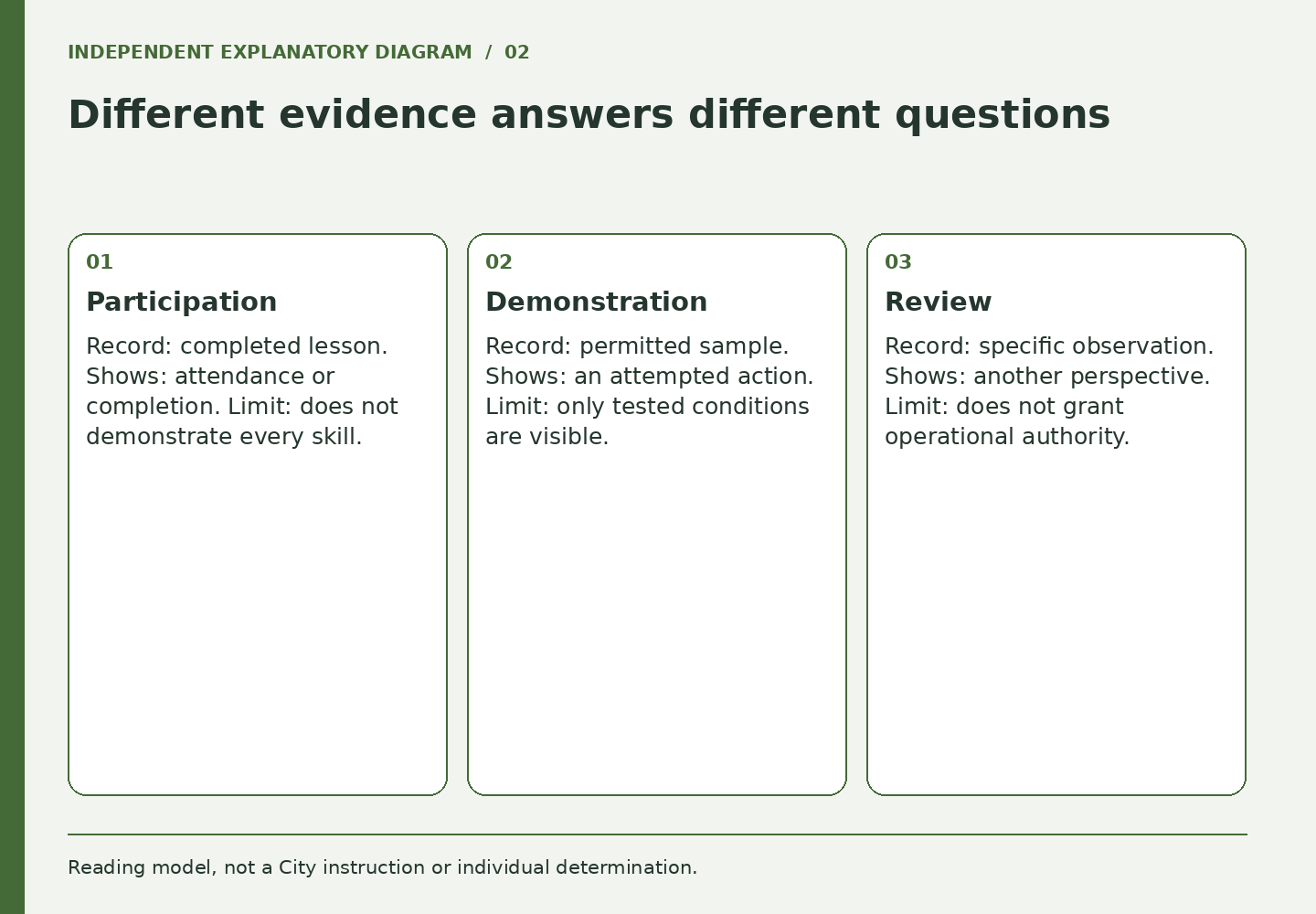
“I completed the course” and “I can do the task” are different statements. Completion is useful evidence of participation. A demonstration can show how you apply a skill. Feedback can reveal whether another person understands the result. None of these records needs to displace the others, but each should have a clear job in your learning plan.
Massachusetts' My Experience Counts glossary distinguishes learning outcomes and supporting evidence in the context of prior learning assessment. This fieldbook borrows the basic distinction between a claim and its evidence for personal development. The worksheet below is not a college-credit portfolio, a certification assessment, or an official City competency framework.
Begin with a verb someone could observe
Pick an action such as compare, explain, organize, check, summarize, or demonstrate. “Understand spreadsheets” is hard to review because it does not specify what you would do. “Explain why a total changes when a filter is applied” provides a much clearer test. The verb should match the level of learning you need. Recognizing a concept is a useful early milestone; independently completing a complex task is a later one.
Pair the action with an object and a condition. For example: summarize a fictional service update in plain language without omitting its deadline. Or organize sample meeting notes so a reader can distinguish decisions from open questions. The condition prevents an attractive-looking artifact from passing while the most important function remains missing.
Select the smallest honest artifact
| Learning claim | Possible practice evidence | What it cannot prove |
|---|---|---|
| I can explain a process | A short explanation using a fictional example | Authority to change the real process |
| I can check a spreadsheet | A marked-up sample with deliberate errors | Readiness to handle confidential live data |
| I can lead a discussion | A timed role-play and observer notes | Consistent performance in every real setting |
Use an artifact you are allowed to create and retain. A recreated sample is often better for learning than a screenshot of a real system. A narrative about your approach can be useful when the actual work cannot be shared. Describe the constraint honestly rather than trying to conceal identifying information in a document that still contains sensitive context.
Give the reviewer a specific question
A request for “any feedback” forces another person to invent the standard. Instead ask, “Can you find the next action without asking me?” or “Which sentence would you read twice?” A narrow question encourages useful observations and reduces the risk that your reviewer will judge irrelevant matters such as their personal formatting preference.
You can agree on two or three criteria before you practice. For an explanation, consider accuracy, completeness, and whether a newcomer can follow it. For a spreadsheet, consider the method, a basic error check, and the explanation of the result. Avoid an elaborate scoring system that suggests more precision than the exercise supports.
Record the conditions with the result
A good note says what you attempted, what help you used, what the reviewer observed, and what remains uncertain. If you followed a tutorial step by step, say so. If the task involved only three sample rows, do not describe it as handling a large dataset. If a colleague corrected an error, record the correction as part of your learning rather than quietly treating it as independent success.
End with a next test that changes one condition. Try another example, remove one prompt, or explain the approach to a different audience. Evidence becomes more useful when it shows where a skill holds up and where you still need support. You do not need a polished portfolio to learn that; a few precise, permitted observations are enough.