The best learning format is not always the most convenient one or the one with the most impressive name. A live workshop can offer discussion but little time to repeat a task. A recording can be paused, yet leave difficult questions unanswered. Guided practice can be highly relevant, but depends on having a suitable reviewer and permission to use the setting. Compare formats against your learning question before comparing their promotional language.
Boston's Be Connected page points employees toward online, in-person, group, and individual training. Its catalog links and older learning-platform references need a fresh check. This article evaluates formats; it does not establish that any particular offering is currently available to you.
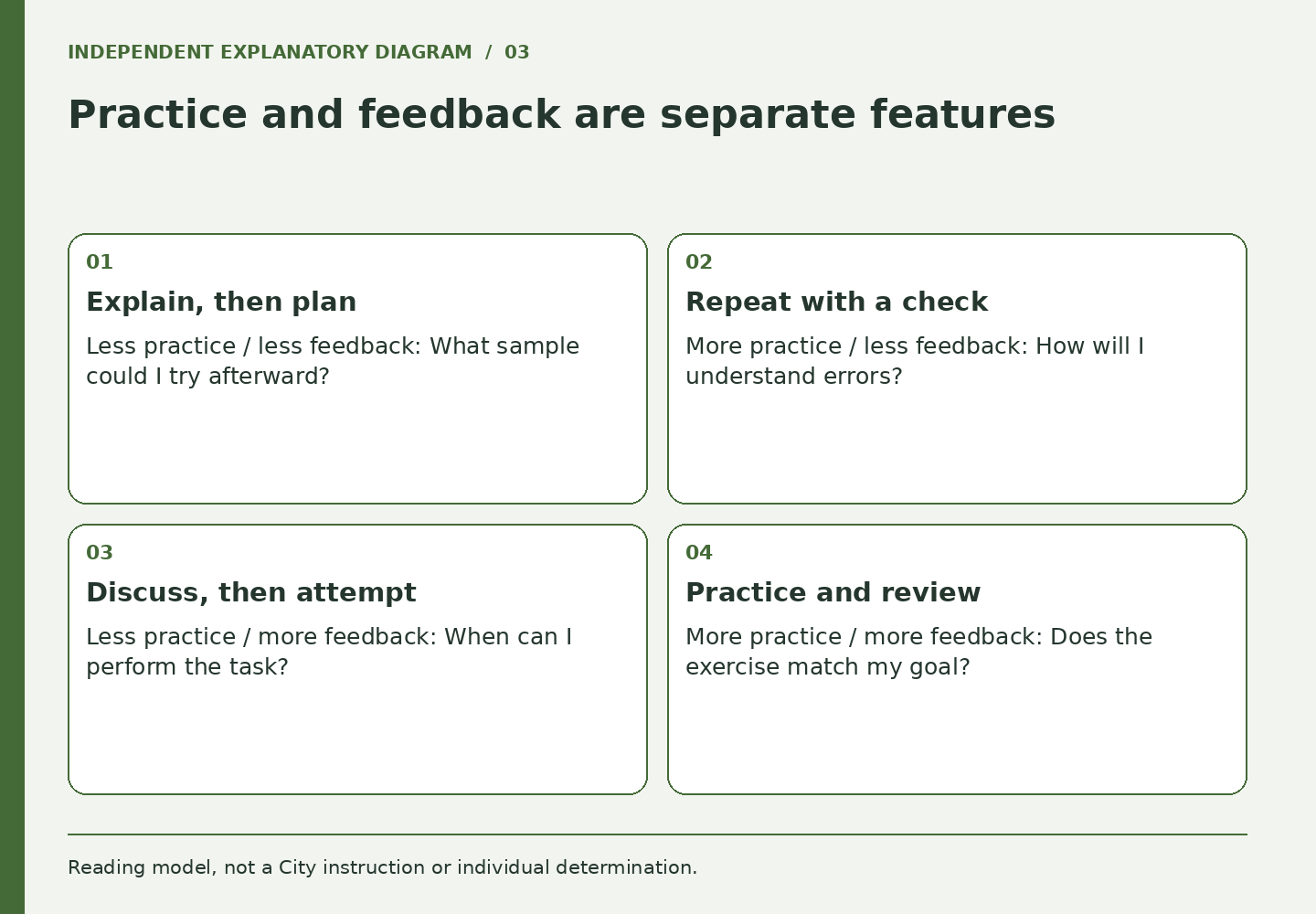
Put feedback and practice on separate axes
Ask two independent questions: will I get to perform the skill, and will someone help me understand the result? A presentation may provide excellent explanations with little practice. A practice library may provide many exercises without human feedback. Neither is automatically inadequate. The issue is whether it matches the part of learning you currently need.
For a factual introduction, a concise reading or recording may be enough to identify your next question. For a difficult conversation, practicing with a willing partner may reveal problems a reading cannot. For a technical procedure, you may need an approved environment and qualified supervision. Do not treat “hands-on” as permission to practice on live systems or equipment.
Compare a small set of concrete features
| Feature | Question to ask | Why it matters |
|---|---|---|
| Practice | What will I make or do? | A topic list can hide a lecture-only format |
| Feedback | Who reviews the attempt, and when? | A score may not explain an error |
| Timing | Which parts must happen at fixed times? | Self-paced does not always mean deadline-free |
| Access | Can I use the materials and required tools? | A format can be convenient yet inaccessible |
Do not turn this into a single numerical ranking unless the tradeoffs are genuinely comparable. An unavailable required practice environment is a blocker, not merely a low score that can be offset by a good price. Separate requirements from preferences before deciding which option fits.
Test the format with a sample
Ask for a sample lesson, exercise, schedule, or description of instructor feedback when the provider makes one available. Try the sample using the device and environment you would normally use. Check whether you can pause, navigate, read diagrams, follow captions, and find the instructions. A polished introduction is not proof that every lesson will work equally well, but it can reveal obvious mismatches.
Consider a fictional learner who wants to explain spreadsheet results clearly. A software demonstration may help with the mechanics, while a short peer review may help with the explanation. The solution could be a combination rather than a longer all-purpose course. Write down which part each resource serves so you do not mistake a collection of materials for a coherent plan.
Choose a reversible first step
Before a major commitment, choose the smallest step that reduces uncertainty: review a syllabus, attend an eligible introductory session, or try a permitted sample exercise. Verify costs and terms before enrolling. Confirm any use of work time, employer tools, or department funds through the appropriate process.
Afterward, ask whether the format produced useful evidence for your goal. If it did, continue deliberately. If it did not, identify the missing feature rather than abandoning the whole subject. You may need a different feedback arrangement, a smaller class, a stronger foundation, or more practice between sessions. Format is a design choice you can revisit.